Comparing WeatherXM with WMO Compliant Weather Stations
Dr. Stavros Keppas, 30/10/23 - WeatherXM AG
1. Introduction
In the pursuit of high-quality meteorological data, we aim to identify potential systematic errors and failures that the various WeatherXM station models may exhibit. For this reason, in the present study we compare impeccably installed WeatherXM weather stations, as assessed by the SPV mechanism (and the installation photos), with nearby meteorological stations that provide data via SYNOP.
2. Data and Methods
In general, there is an inconsistency between airport data and that from WeatherXM stations, mainly in terms of the temporal sampling interval, but also in the set of available parameters.
WeatherXM stations, under normal conditions (good connectivity), provide data every 1–3 minutes, whereas airport stations provide data every 30–180 minutes. For this reason, we aggregated WeatherXM's data in such a way that both data are aligend. For the aggregation method we averaged the observations 5 minutes before and after the timestamp of the WMO complinat station data (vector average for wind direction). In addition, the parameters provided by WeatherXM stations are consistent, while the parameters from airport stations often vary from station to station (for example, sometimes wind gust is missing, or the time step used for recording precipitation differs).
Finally, although the reliability of satellite precipitation retrievals is not yet at a level where we could fully trust them, we use the IMERG product with a spatial resolution of 0.1°. It is worth noting, however, that for the latest 3 months the data are only partially processed and may therefore have lower reliability. Full processing takes place after the 3-month period.
3. Comparisons
a. Thessaloniki Airport (Greece) vs WeatherXM H1
For this comparison, we used the data (between 11/2024 - 11/2025) from SYN16622 (SYNOP Mesonet) at the Thessaloniki Airport and the WeatherXM H1 station (Humid Myrtle Hygrometer). The distance between the two stations is <2km, which allows for a valid comparison between them (Figure 1).
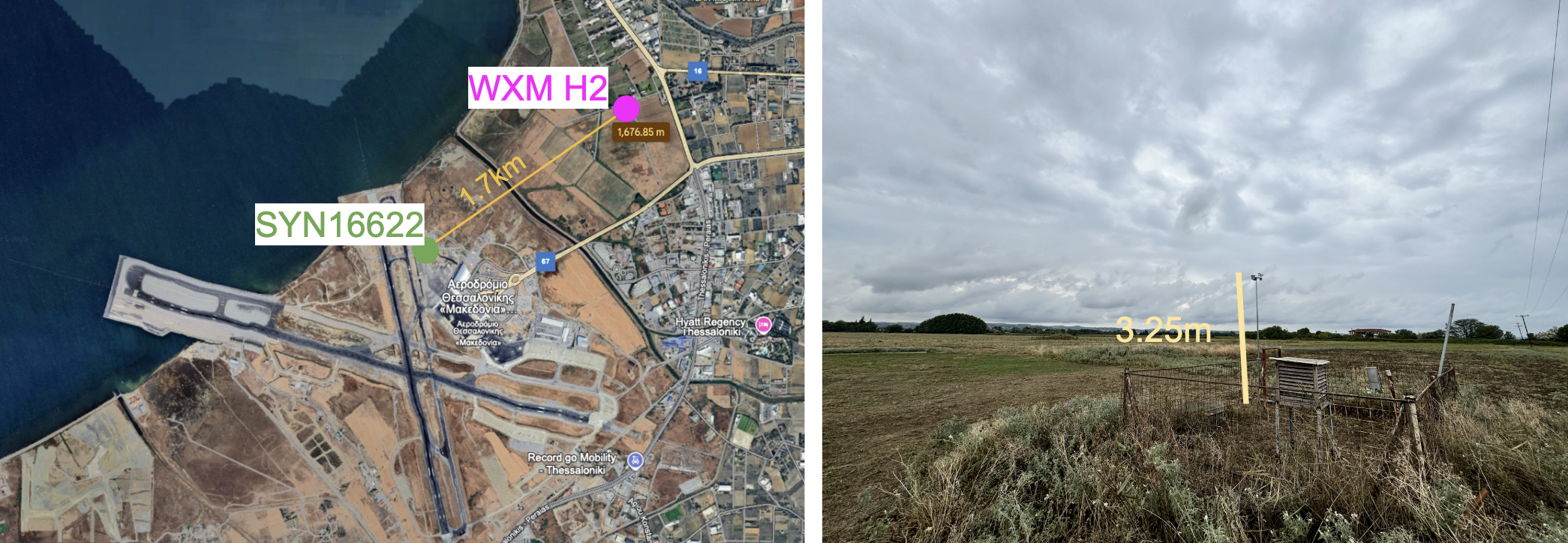
Figure 1. (Left) Map with the locations and the distance between the SYN16622 and the WeatherXM H1 stations. (Right) WeatherXM H1 deployment photo.
From Figure 2, we can draw some useful conclusions, which are summarised in the following points:
- There is fair temperature agreement (usually WXM is lower - possible reasons could be the slightly different land use, lower mast leading to lower temperature in cloudless nights)
- There is fair wind direction agreement
- The weatherXM station underestimates wind speed/gust possibly due to shorter mast (3m instead of 10m)
- Significant discrepancy in precipitation, which needs further investigation
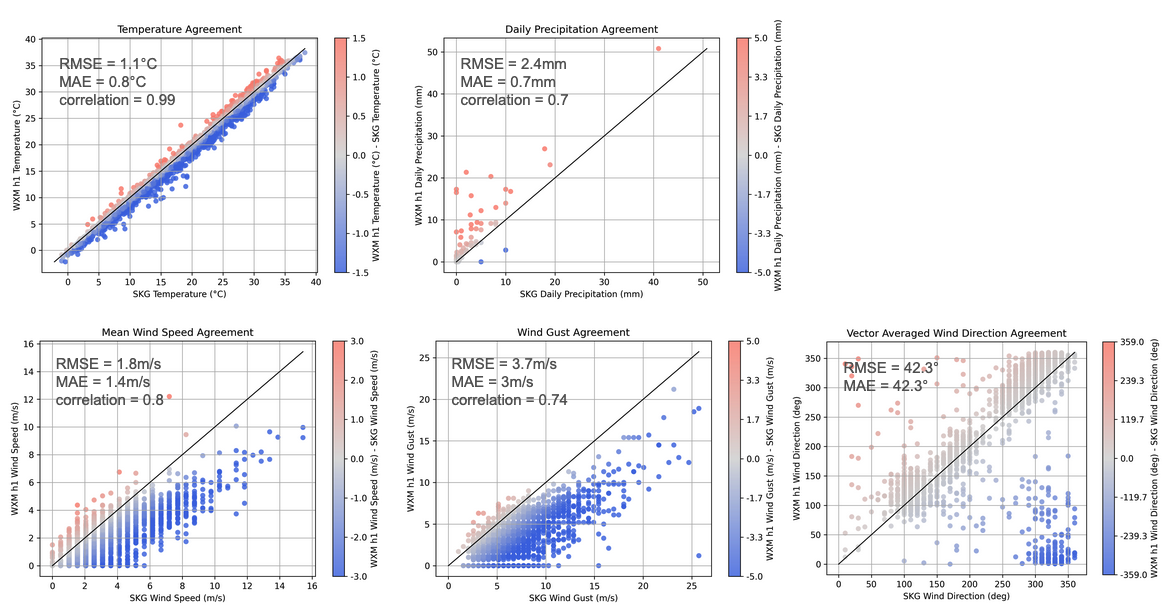
Figure 2. Agreement plots between SYNOP16622 and WeatherXM H1 temperature, daily precipitation, wind speed, wind gust and wind direction. The markers are coloured depending on their distance from the agreement line.
Looking at the full time series of temperature, wind gusts and daily precipitation, we can see that, broadly, variations seem to be in agreement. The SYNOP16622 wind gusts are never 0m/s at the airport, which may be due to a very sensitive wind gauge under calm conditions. Regarding precipitation, it seems that there is some agreement between SYNOP16622 and WeatherXM, but there is some difference in rain amount on certain episodes. It should be noted that the SYNOP16622 has larger distance from IMERG (Figure 3).
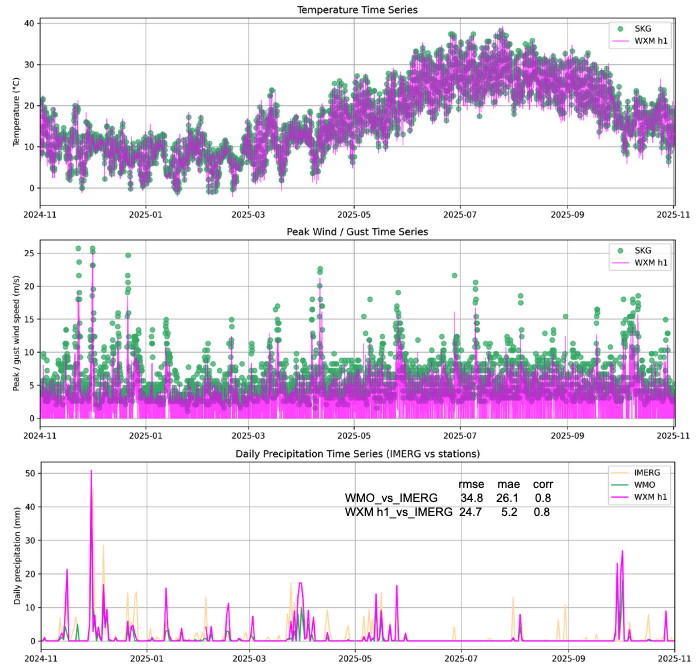
Figure 3. Temperature, wind gust and daily precipitation time series plots of both SYNOP16622 and WeatherXM H1.
As we detected a significant deviation in precipitation recorded by WeatherXM H1 and SYN16622, we tried to find more references in order to understand which could be the ground truth. For this reason we used monthly accumulation from the Davis VP2 weather station supported by the National Observatory of Athens (NOA) (which is located ~3-4km from SYN16622 and WeatherXM H1) and IMERG precipitation retrievals.
It seems that the WeatherXM H1 station is usually closer to any of IMERG and NOA (Davis VP2), while SYN16622 is far from all the other references. In particular, SYN16622 seems to significantly underestimate monthly precipitation by up to ~50% even in winter months (when precipitation may exhibit a more uniform spatial distribution as convective activity is limited in the area).
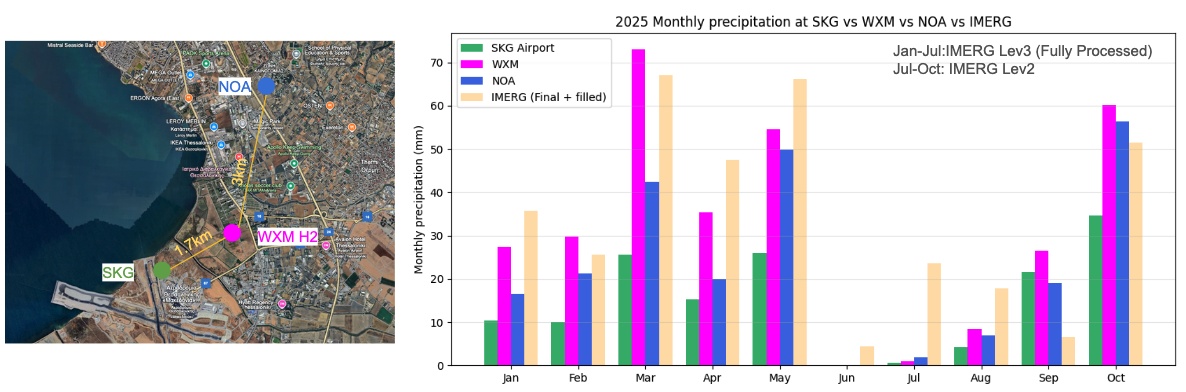
Figure 4. (Left) Map with the locations and the distance between the SYN16622 (WMO), WeatherXM H1 and the National Observatory of Athens stations. (Right) Bar graph of total monthly precipitation recorded by the 3 stations and retrieved by IMERG.
b. Rockwall Municipal Airport (Dallas) vs WeatherXM H2
For this comparison, we used the data (between 11/2024 - 11/2025) from KF46 (ASOS/AWOS Mesonet - Following some general WMO guidelines) at the Rockwall Municipal Airport and the WeatherXM H1 station (Dandy Marigold Rainband). The distance between the two stations is ~20km over a flat area, which may allow for a valid comparison between them (Figure 5).
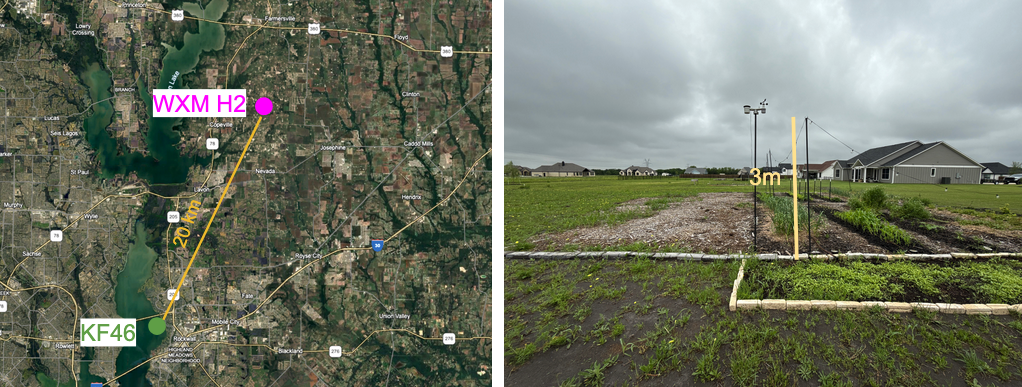
Figure 5. (Left) Map with the locations and the distance between the KF46 and the WeatherXM H2 stations. (Right) WeatherXM H1 deployment photo.
From Figure 6, we can draw some useful conclusions, which are summarised in the following points:
- There is a fair temperature agreement
- There is a fair wind direction agreement
- WeatherXM H2 seems to underestimate wind speed/gust due to shorter mast (3m instead of 10m)
- A weird cut-off threshold is present in wind speed/gust observations recorded by the KF46
- There is a reasonable discrepancy in precipitation. The distance between stations can justify such differences especially during summer (due to convective activity)
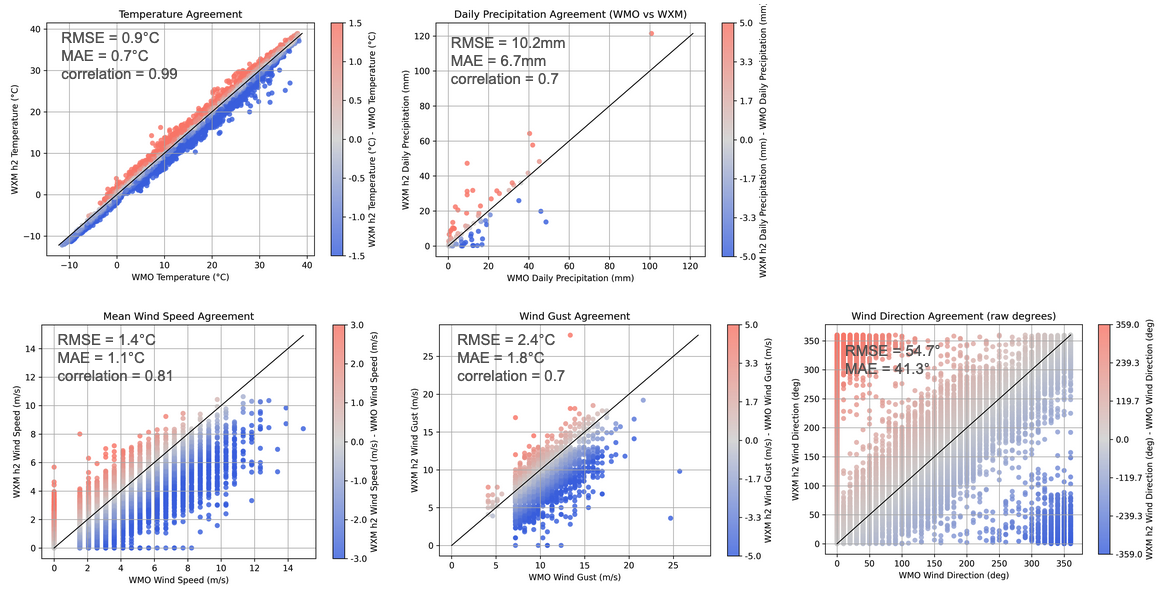
Figure 6. Agreement plots between KF46 and WeatherXM H2 temperature, daily precipitation, wind speed, wind gust and wind direction. The markers are coloured depending on their distance from the agreement line.
Looking at the full time series of temperature, wind gusts and daily precipitation, we can see that, broadly, variations seem to be in agreement. The KF46 wind gusts are never 0m/s at the airport, and usually >7m/s (which may be suspicious). Regarding precipitation, it seems that there is a fair agreement between KF46, WeatherXM and IMERG considering the distance between the stations (Figure 7).
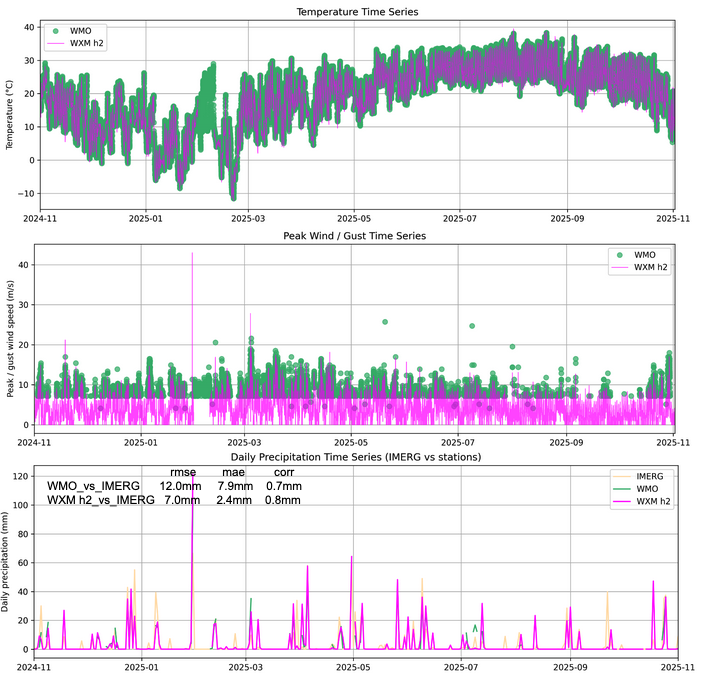
Figure 7. Temperature, wind gust and daily precipitation time series plots of both KF46 and WeatherXM H2.
Finally, comparing the stations between them and both with the monthly IMERG precipitation retrievals, we found that all three sources of precipitation measurements are usually in fair agreement. KF46 and WeatherXM H2 are often close each other, while large discrepancies in certain months may be due to convective activity and distance between stations.
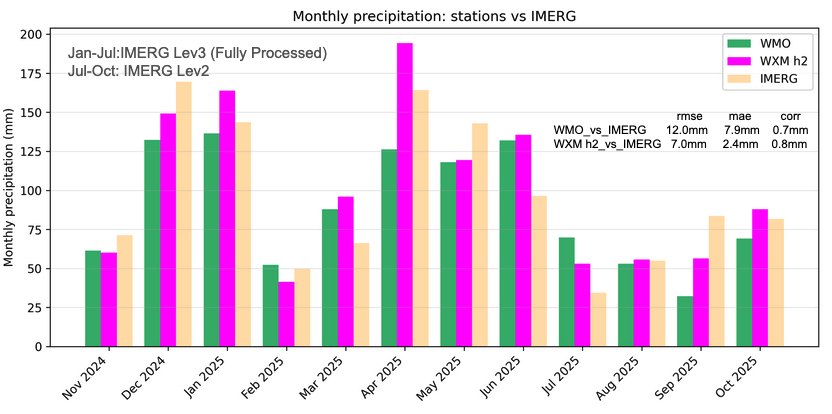
Figure 8. Bar graph of total monthly precipitation recorded by the the KF46 (WMO), WeatherXM H2 stations and retrieved by IMERG.
c. Osijek Airport (Croatia) vs WeatherXM H1
For this comparison, we used the data (between 11/2024 - 11/2025) from SYN14280 (SYNOP Mesonet) at the Osijek Airport and the WeatherXM H1 station (Convective Chestnut Moisture). The distance between the two stations is ~14km over a generally flat area, which may allow for a valid comparison between them (Figure 9).
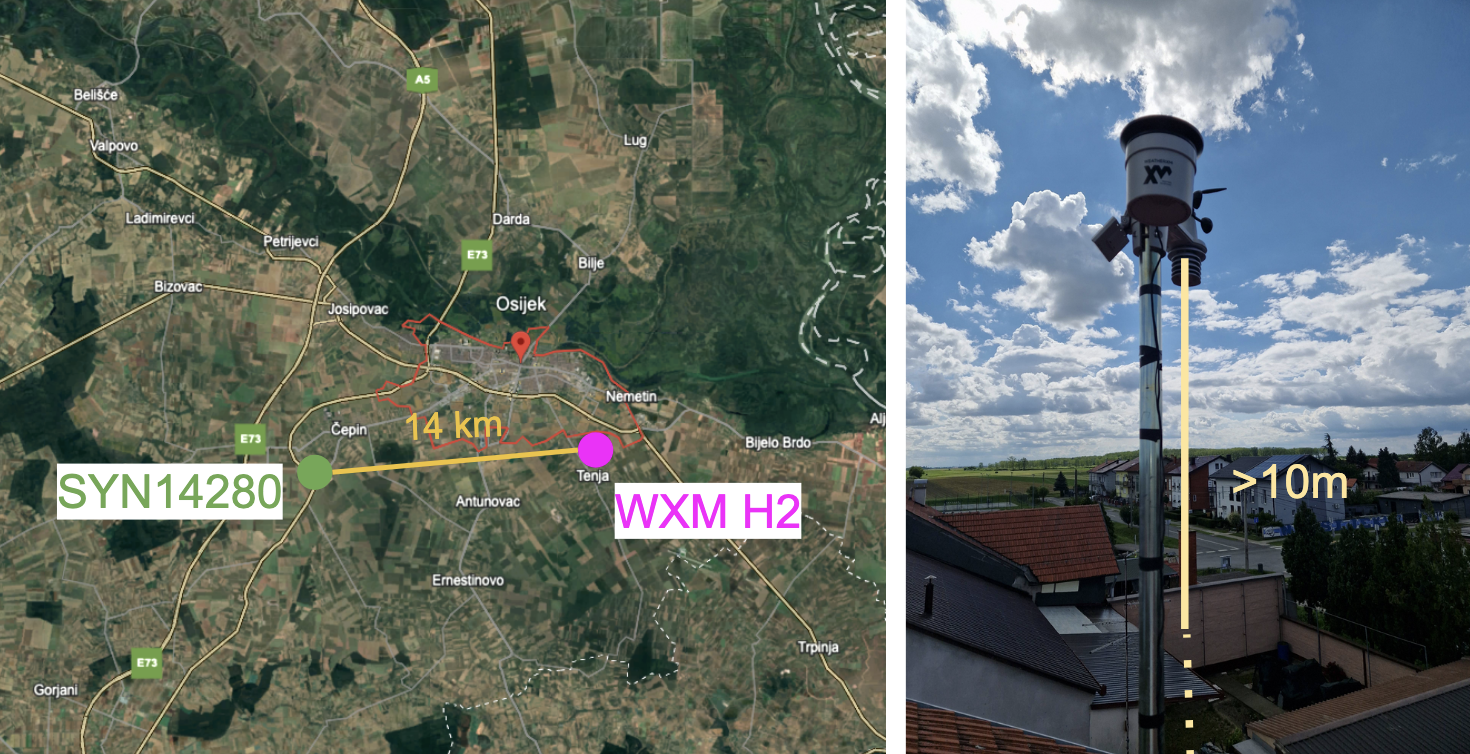
Figure 9. (Left) Map with the locations and the distance between the SYN14280 and the WeatherXM H1 stations. (Right) WeatherXM H1 deployment photo.
From Figure 10, we can draw some useful conclusions, which are summarised in the following points:
- There is a fair temperature agreement
- There is a fair wind direction agreement (possibly because the WeatherXM station is ~10m above the ground and thus, the deployments are comparable)
- WeatherXM H1 seems to slightly underestimate wind speed/gust due to shorter mast (3m instead of 10m)
- The wind gust measurements were not available from the SYN14280 station, so no comparison could be conducted
- Some discrepancy in precipitation is present. The distance between station may be able to justify such differences especially during summer.
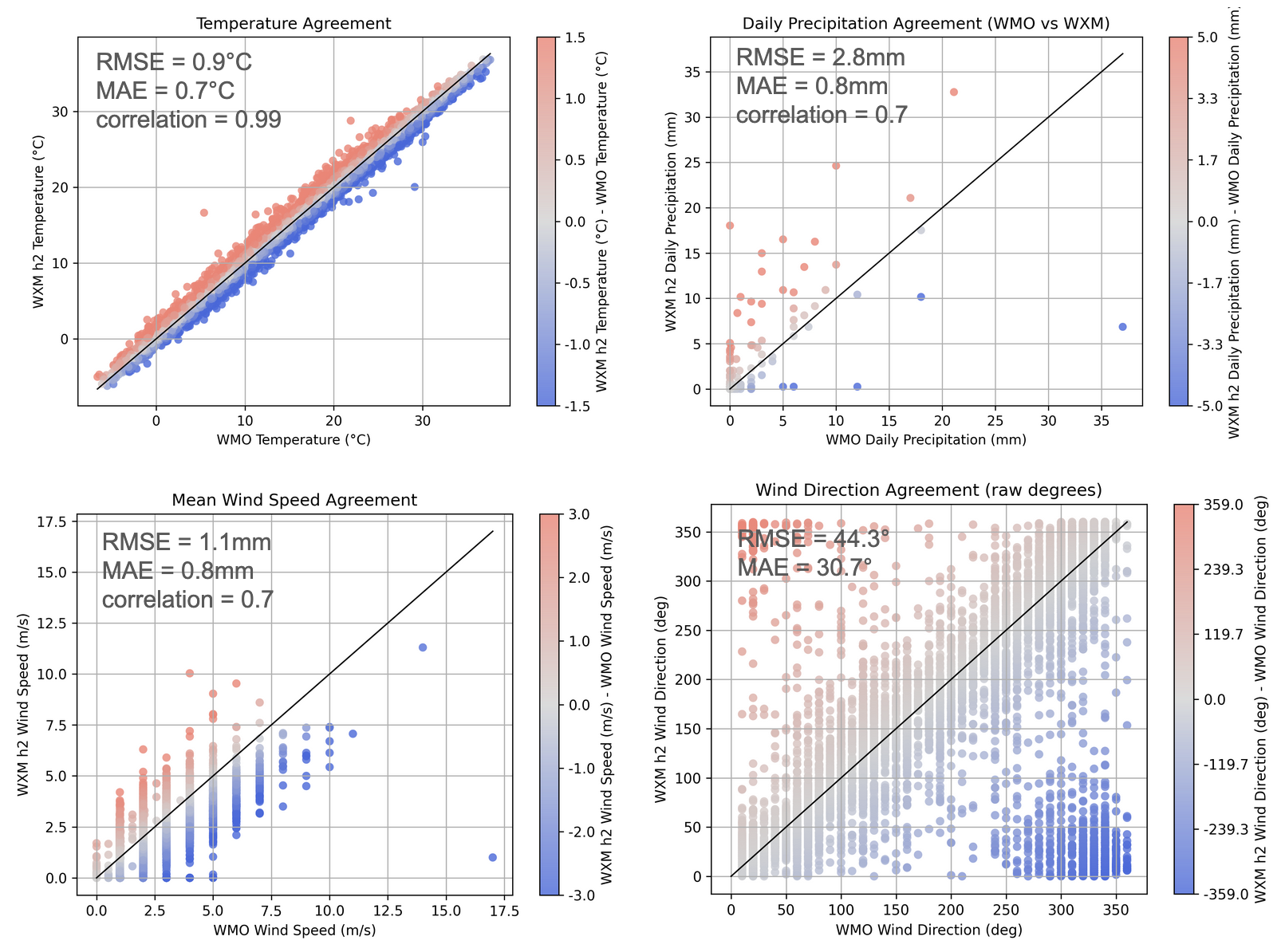
Figure 10. Agreement plots between SYN14280 and WeatherXM H1 temperature, daily precipitation, wind speed and wind direction. The markers are coloured depending on their distance from the agreement line.
Looking at the full time series of temperature, wind gusts and daily precipitation, we can see that, broadly, variations seem to be in agreement. The SYN14280 usually records lower amounts of precipitation comparing to the WeatherXM H1 and IMERG. However, during summertime, it seems that SYN14280 recorded larger amounts, which may be due to intense convective activity (Figure 11-12).
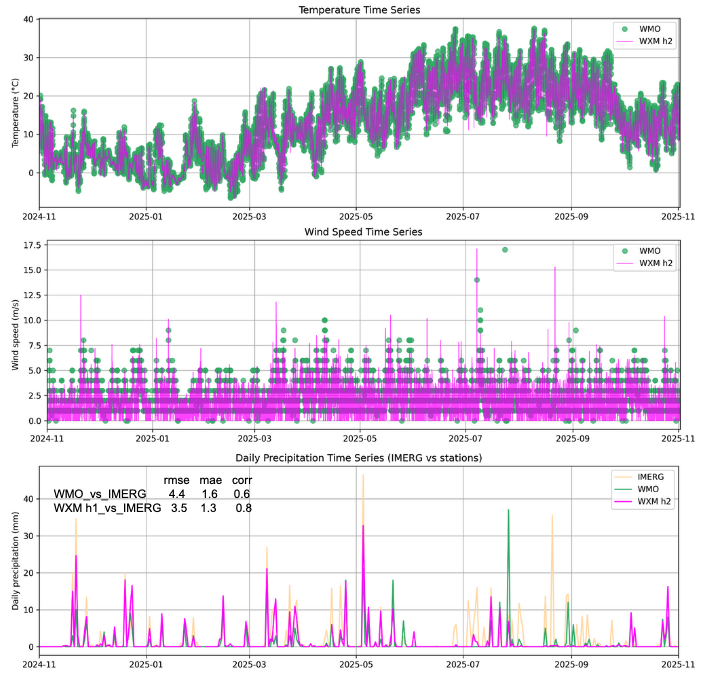
Figure 11. Temperature, wind gust and daily precipitation time series plots of both SYN14280 and WeatherXM H1.
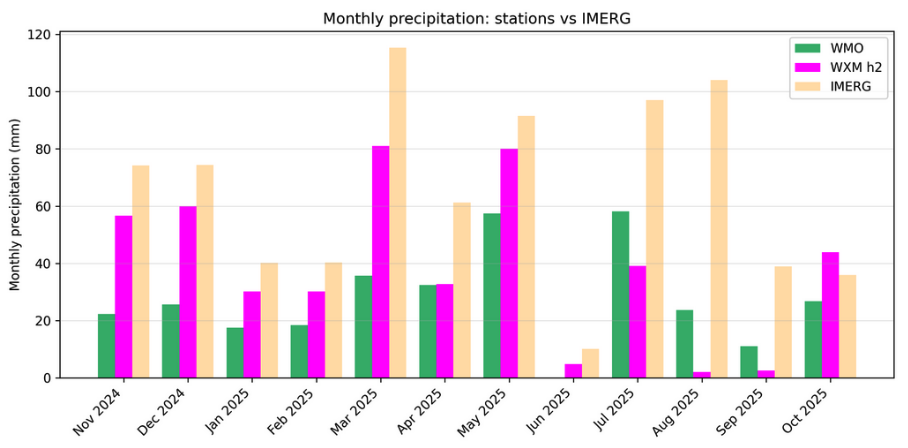
Figure 12. Bar graph of total monthly precipitation recorded by the the SYN14280 (WMO), WeatherXM H1 stations and retrieved by IMERG.
d. Kortrjik Airport (Belgium) vs WeatherXM H1
For this comparison, we used the data (between 03/2024 - 11/2025) from SYN06414 (SYNOP Mesonet) at the Kortrjik Airport and the WeatherXM H1 station (Hot Nickel Stratus). The distance between the two stations is ~14km over a generally flat area, which may allow for a valid comparison between them (Figure 13).
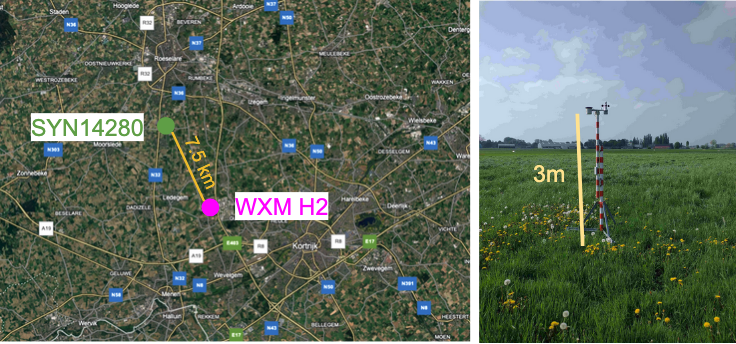
Figure 13. (Left) Map with the locations and the distance between the SYN06414 and the WeatherXM H1 stations. (Right) WeatherXM H1 deployment photo.
From Figure 14, we can draw some useful conclusions, which are summarised in the following points:
- There is fair temperature agreement
- There is fair wind direction agreement
- There is also fair wind speed agreement
- Wind gust measurements are not available from WMO's station
- We found some discrepancy in precipitation between the two stations. WeatherXM station seems to catch rain episodes that WMO misses. This may happen during convective phenomena, but it needs further investigation.
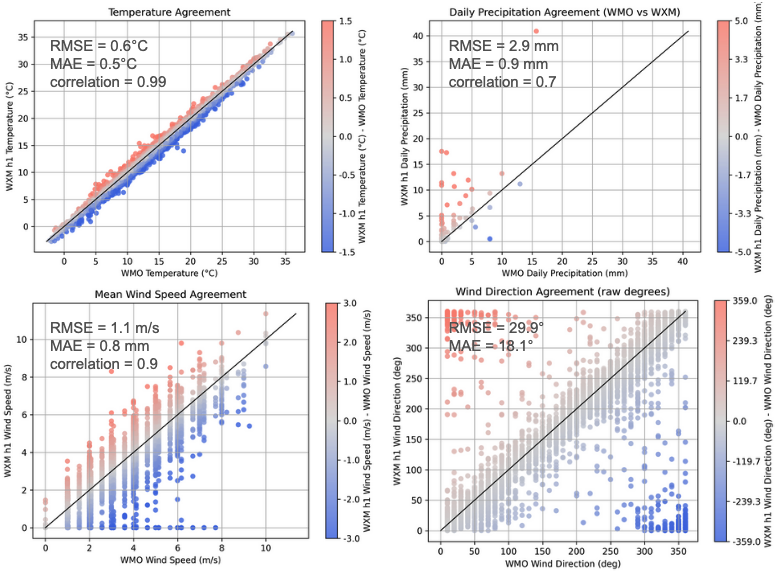
Figure 14. Agreement plots between SYN06414 and WeatherXM H1 temperature, daily precipitation, wind speed and wind direction. The markers are coloured depending on their distance from the agreement line.
Broadly, variations seem to be in agreement. There is a fair agreement in wind speed measurements despite the possible difference in mast height of the stations. Again, WeatherXM often measures larger amount of rain than WMO's station. However, there is coincidence of most episodes. Unfortunately, IMERG seems to exhibit false positives especially after August (Figure 15).
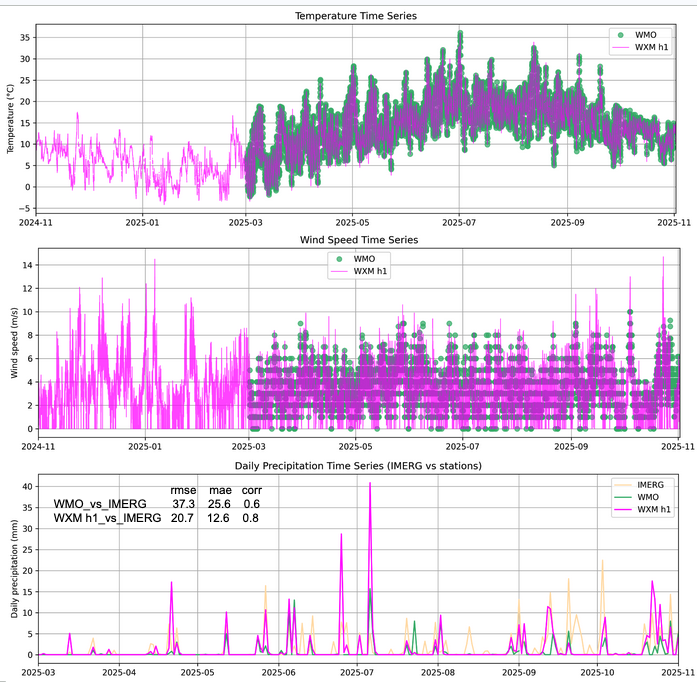
Figure 15. Temperature, wind gust and daily precipitation time series plots of both SYN06414 and WeatherXM H1.
Looking at the monthly accumulations of precipitation (Figure 16), we can see significant discrepancy between the WMO, WeatherXM stations and IMERG retrieval. Although WeatherXM station seems to be closer to IMERG, it eventually seems that a reliable ground truth is missing.
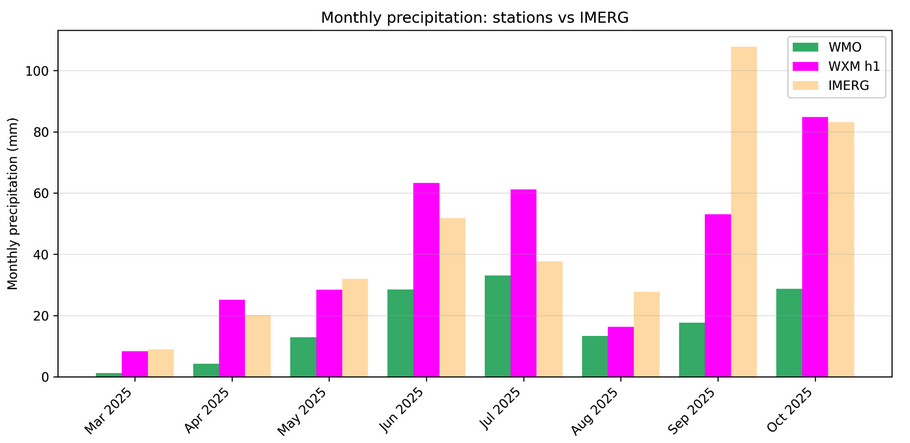
Figure 16. Bar graph of total monthly precipitation recorded by the the SYN06414 (WMO), WeatherXM H1 stations and retrieved by IMERG.
3. Conclusions
After investigating a few couples of WeatherXM, we draw the following conclusions:
- There is always a fair agreement in temperature in all couples
- There is a fair agreement in wind direction (considering the variability of wind flow due to topography and even artificial objects)
- In general there is a good agreement in wind speed considering that WeatherXM stations are mounted on 3m masts instead of 10m. However, there was a great agreement when a WeatherXM station was mounted on the roof of a ~10m building.
- The wind speed observations recorded by WMO’s stations are sometime in intervals of 0.5-1m/s, which may raise questions on accuracy.
- There are cases of data gaps in precipitation recorded by WMO stations resulting to mising episodes.
- WMO’s large discrepancy in precipitation even when WeatherXM stations are as far as ~1-2km. IMERG and 3rd party realiable stations confirm the WMO’s inaccuracy in precipitation is some cases.
- The WeatherXM stations usually record larger amount of rain per episode. Considering that the rain gauge is shallow and with small diameter, we would expect WMO stations to record systematically larger amounts of rain
- In the end, it seems that we are still in the pursuit of publically available reference/ground truth observations of precipitation